


LED Downlight Colour Temperature Guide (2700K–6500K)

By ARCK Electrical · Trade counter, North Parramatta · Reviewed May 2026
Quick Q&A — click to expand
What colour temperature for a bathroom? +
4000K is the trade default for bathrooms — cleaner light makes shaving, makeup and reading labels easier. Some customers prefer 3000K for a softer 'spa' feel, especially in master ensuites with a separate showering area. Both work. Match the kitchen for consistency if the bathroom shares a sightline. Always use IP-rated downlights in shower zones per AS/NZS 3000.
Should I match the existing downlights or replace the lot? +
If you're patching a couple of failed lights into an existing fit-out, match temperature and beam angle as closely as you can — a 3000K replacement in a 4000K ceiling will look like a fault. If the existing fittings are old-spec (low CRI, no dimmability, fading) and the customer wants to spend the money, a full replacement gives a consistent finish and a chance to upgrade to tri-colour for future flexibility.
Are tri-colour downlights worth it? +
For most domestic fit-outs, yes. One part number covers bedrooms, living, kitchen and bathroom — set the temperature per room with a DIP switch before fitting. Stock management on the van gets simpler. The price premium over fixed-temperature fittings is small, and the flexibility pays off when a customer changes their mind on temperature mid-job. For high-end commercial or retail where colour rendering matters more, fixed-temperature high-CRI fittings still win.
What's CRI and why does it matter? +
CRI (colour rendering index) measures how accurately a light source renders the colours of objects compared with natural sunlight. Ra80 is the domestic minimum and is fine for general living areas. Ra90+ is what you want in kitchens, bathrooms, retail and anywhere the customer cares about how things look — clothes, food, skin tones. Cheap Ra70 downlights make everything look washed out and are a false saving.
Colour temperature is one of those decisions you make once on a fit-out and live with for the next ten years. Get it wrong on the lounge and the customer will tell you about it every time you walk back in.
Here's the trade version of what the numbers mean and how to pick.
The Kelvin scale in plain English
Colour temperature is measured in kelvin (K). Lower numbers are warmer (yellower); higher numbers are cooler (whiter and bluer).
It's the colour the LED emits, not the colour the room ends up — a 4000K downlight over a beige wall and a 4000K downlight over a white-tiled bathroom will look noticeably different. The four working bands you'll deal with on a domestic fit:
- 2700K — warm white. Yellow-leaning. The closest thing to old incandescent. Bedrooms, formal lounges, hospitality spaces. The colour customers describe as "cosy".
- 3000K — soft white. Slightly less yellow than 2700K. Still warm, but cleaner. The most common pick for living areas, hallways and bedrooms in modern domestic fit-outs.
- 4000K — neutral white / "natural white". White without obvious warm or cool bias. Kitchens, bathrooms, laundries, workspaces, garages. Where you need to see what you're doing.
- 5000–6500K — cool white / daylight. Cooler, slightly blue-leaning. Garages, workshops, retail, commercial. Most domestic spaces look harsh under 6500K.
The shift between adjacent bands (2700K to 3000K, 3000K to 4000K) is noticeable. The shift inside a band — 4000K vs 4500K — is subtle and most customers won't pick it out side-by-side.
Where each temperature suits
A rough room-by-room cheat sheet for a typical Sydney domestic fit-out:
- Bedrooms — 2700K or 3000K. Bedside reading still works at 3000K with good CRI.
- Lounge / family room — 3000K. The default. Customers who want a "cosier" feel go 2700K.
- Kitchen — 4000K. Cleaner light makes food prep easier and shows off the splashback.
- Bathroom — 4000K. Better for shaving, makeup, and reading labels. Some customers want 3000K for a softer feel — both work.
- Hallway / stairs — 3000K or 4000K. Match the rooms they connect.
- Study / home office — 4000K. Whiter light, less eye fatigue under sustained reading.
- Laundry / pantry — 4000K.
- Garage / workshop — 4000K or 5000K.
- Outdoor (alfresco, eaves) — 3000K to 4000K depending on the look.
In stock at ARCK
Tri-colour and CCT downlights in stock


Call the North Parramatta trade counter on (02) 9890 9693 if you want a hand picking the right one — Mon–Fri 6:30am–5pm, Sat 7:30am–1pm.
Tri-colour and CCT-switchable downlights
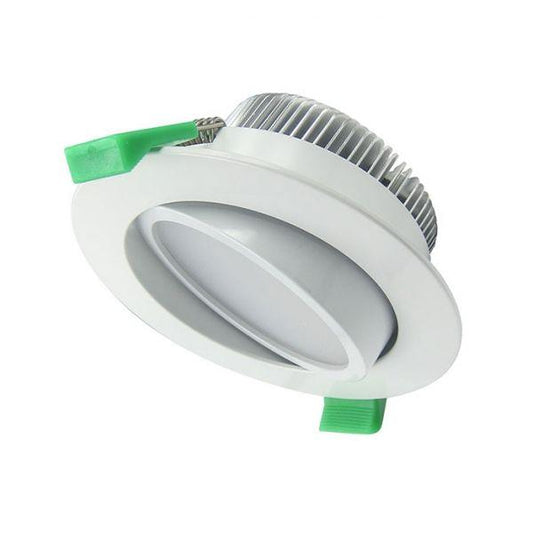
A lot of modern downlights — 3A Lighting, Mercator, Havit and others — are CCT-switchable. A small switch on the back of the fitting (or sometimes on the driver) lets the installer pick 3000K, 4000K, or 5000K from the one product.
Tri-colour fittings have made stock management vastly simpler — one part number on the van covers most of the house. The trade-off is a slight colour shift between batches and a small price premium over fixed-temperature fittings.
For most domestic fit-outs, the simplicity wins. A tip: set the switch before you fit them.
It's faster to flick the DIP switch on the bench than to climb back up the ladder.
Tri-colour and fixed downlights
3A Lighting, Havit, Mercator, CLA, Trend — trade pricing across the range.
Browse lighting →CRI — colour rendering
Colour temperature is what the light looks like; CRI is how accurately it shows the colours of the things it lights up.
- Ra80 is the domestic minimum. Most cheaper downlights sit here. Adequate for general living and bedrooms.
- Ra90+ is what you want for kitchens, bathrooms, retail, food prep, and anywhere the customer cares about how things look — clothes, makeup, food.
Cheap Ra70 downlights show up as flat, washed-out colour. They're a false saving on most jobs.
Mixing temperatures across a fit-out
Don't mix temperatures in the same visible space. A 3000K downlight next to a 4000K one looks like a fault.
The eye is good at picking out the difference even when the customer can't explain why it looks off. Splitting by room is fine — 3000K throughout the living and bedroom areas, 4000K in kitchens and wet areas, is a common and well-tolerated layout.
If the kitchen is open-plan to the lounge, decide which side wins. A 4000K kitchen with a 3000K living area in the same sightline is a customer call — show them both before you cut holes.
Compliance note
Electrical work in Australia must be carried out by a licensed electrician under AS/NZS 3000. Lighting selection is a design call, but installation, circuit design, and protection all sit inside the standard.
Order from ARCK
Tri-colour and fixed-temperature downlights from 3A Lighting, Mercator, Havit, CLA, Trend and more — domestic and commercial, dimmable and non-dim, IP-rated for wet areas. Same-day pick-up from North Parramatta.
Browse the full lighting range, or call the counter on (02) 9890 9693 for stock and pricing on bulk fit-outs. Mon–Fri 6:30am–5pm, Sat 7:30am–1pm.
In stock at ARCK
Tri-colour and CCT downlights in stock
Call the North Parramatta trade counter on (02) 9890 9693 if you want a hand picking the right one — Mon–Fri 6:30am–5pm, Sat 7:30am–1pm.